


Artificial intelligence is reshaping cybersecurity at a pace few organizations anticipated. What once took attackers days or weeks can now happen in a fraction of the time, putting new pressure on IT and security teams to reduce the window between vulnerability discovery and remediation.
This shift is forcing organizations to rethink long-standing patching practices. Traditional deployment cycles and manual workflows were built for a different era. Today, speed, prioritization, and operational agility matter just as much as deployment itself.
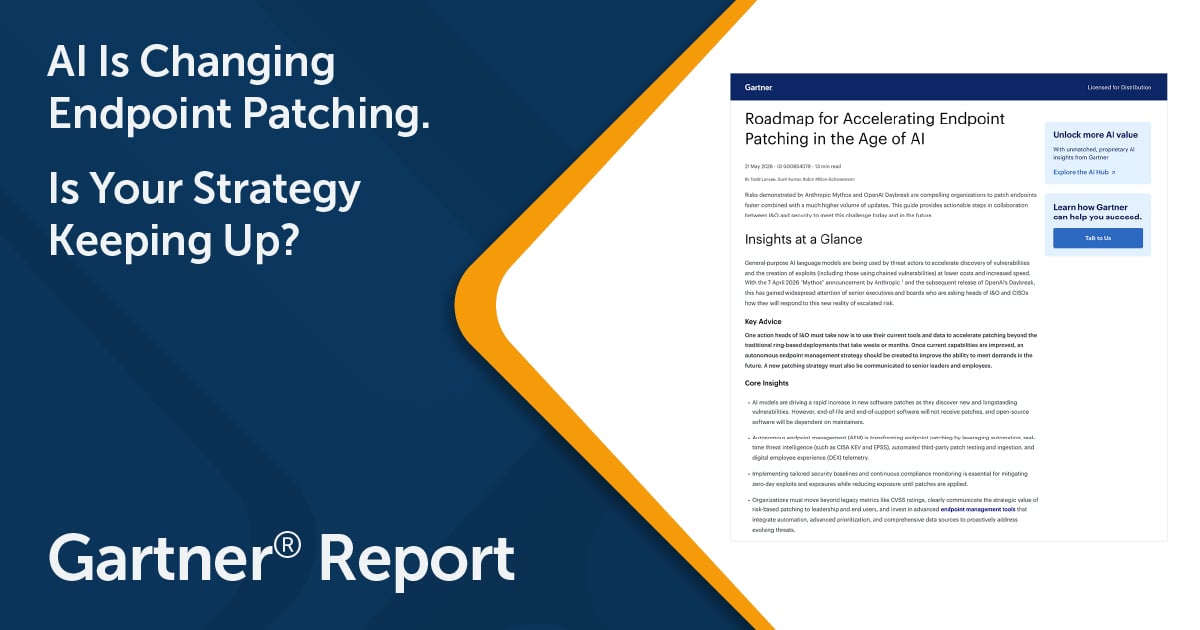
These are among the themes explored in the Gartner® report, Roadmap for Accelerating Endpoint Patching in the Age of AI, which examines how organizations can modernize endpoint patching to keep pace with AI-driven threats.
Why is AI forcing organizations to rethink endpoint patching?
AI is making attacks more sophisticated AND faster.
As Gartner explains:
"General-purpose AI language models are being used by threat actors to accelerate discovery of vulnerabilities and the creation of exploits (including those using chained vulnerabilities) at lower costs and increased speed. [The announcements of leading frontier AI models this year] has gained widespread attention of senior executives and boards who are asking heads of I&O and CISOs how they will respond to this new reality of escalated risk."The implications extend beyond cybersecurity teams. As exploit timelines compress, organizations have less time to assess risk, validate updates, and deploy patches before vulnerabilities become active attack vectors.
The question becomes: is the patching strategy designed for a machine-speed threat environment?
How can organizations accelerate patching without replacing existing tools?
For many organizations, the answer is getting more from the tools they already have.
Gartner recommends:
"Accelerate patching with what you have today. This can be done by reducing patch deployment and assessment times by using DEX to quickly assess impacts, using exploit and threat assessment data to prioritize certain patches, and using automation that may already be in your existing tools."This recommendation highlights an important shift in thinking. Before introducing new technology, organizations should ensure they are fully leveraging the automation, threat intelligence, and endpoint data already available within their existing environments. At the same time, leaders should assess whether their current endpoint management capabilities are sufficient to support the speed, prioritization, and automation of today's threats.
For many organizations, accelerating patching will ultimately require both operational improvements and modern endpoint management capabilities that integrate threat intelligence, automation, and dynamic prioritization into a single workflow.
Why isn't patching faster enough to reduce risk?
Accelerating patch deployment is necessary, but speed alone no longer determines security outcomes. Organizations also need to prioritize the right vulnerabilities, eliminate operational delays, and continuously adapt as threats evolve.
Gartner notes that traditional approaches are reaching their limits:
"When prioritized and targeted patches are deployed based on threats and exploits, the static ring-based deployment will no longer suffice. Patching metrics assessing deployment according to [federal agencies] are out-of-date. With [this year's announcement that federal agencies] will no longer attempt to categorize all vulnerabilities due to overwhelming numbers, these cannot solely or primarily be relied upon. Metrics and reporting must be revised to properly assess your environment and effectiveness. Longstanding change management processes must also be updated for this new acceleration."This represents a fundamental shift in endpoint management. Organizations must build patching strategies that incorporate richer threat intelligence, dynamic prioritization, and operational processes designed to keep pace with AI-driven threats.
What this means for IT and security leaders
Endpoint patching has become more than an operational task and is now increasingly a measure of organizational resilience.
As AI accelerates both vulnerability discovery and exploit development, leaders should evaluate whether their current patching processes are built for today's realities or yesterday's. That includes asking where manual approvals create unnecessary delays, whether prioritization reflects real-world risk, and how effectively security and IT teams coordinate remediation.
The organizations that adapt fastest will be the ones reducing operational friction so they can respond more consistently when new threats emerge.
Where Adaptiva fits into AI-ready endpoint management
Organizations evaluating their endpoint strategy can use Gartner's roadmap to assess where current processes create unnecessary delays and how AI-ready patching practices can improve resilience. Adaptiva helps organizations put those recommendations into practice through its autonomous endpoint management platform. By connecting AI-driven prioritization, autonomous patching, third-party application support, and enterprise-scale content distribution into a unified workflow, Adaptiva helps organizations accelerate remediation while reducing operational complexity.
To learn more about how AI is reshaping endpoint patching and the practical steps organizations can take to prepare, download the Gartner® Roadmap for Accelerating Endpoint Patching in the Age of AI.
Gartner, Roadmap for Accelerating Endpoint Patching in the Age of AI, By Todd Larivee et. al, 21 May 2026
GARTNER is a trademark of Gartner, Inc. and/or its affiliates.
Gartner does not endorse any company, vendor, product or service depicted in its publications, and does not advise technology users to select only those vendors with the highest ratings or other designation. Gartner publications consist of the opinions of Gartner’s business and technology insights organization and should not be construed as statements of fact. Gartner disclaims all warranties, expressed or implied, with respect to this publication, including any warranties of merchantability or fitness for a particular purpose.
This graphic was published by Gartner, Inc. as part of a larger research document and should be evaluated in the context of the entire document. The Gartner document is available upon request from Adaptiva.