


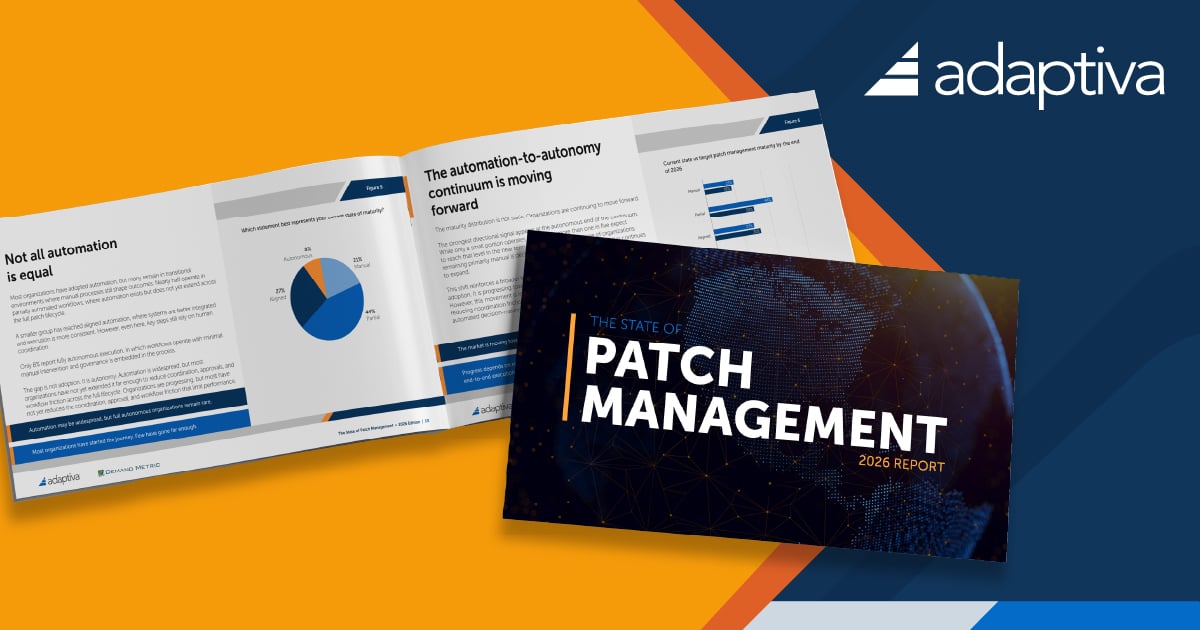
Adaptiva today released findings from its State of Patch Management 2026 Report, revealing that while enterprises are accelerating automation and patch deployment speeds, most organizations still lack the operational maturity needed to consistently reduce risk at scale.
Conducted in partnership with Demand Metric, the research surveyed more than 200 IT and security professionals to assess how enterprises are evolving patch management strategies in response to rising vulnerability volumes, AI-assisted cyberattacks, and shrinking remediation windows.
The findings point to a growing disconnect within enterprise security operations: organizations are rapidly adopting automation, but many continue to struggle with fragmented workflows, manual coordination, and inconsistent execution across the patch lifecycle. As attackers increasingly operate at machine speed, the report shows that operational maturity, not autonomous adoption alone, is emerging as the defining factor separating resilient organizations from those still constrained by human bottlenecks and workflow friction.
Here’s a breakdown of the report’s major findings and the operational trends shaping enterprise patch management in 2026.
Fragmented Automation is Slowing Patch Maturity
The report also highlights how many organizations continue to struggle with fragmented automation and disconnected workflows.
While 44% of organizations report partially automated patching workflows, more than 60% still rely on manual processes at some point in the patch lifecycle. Only 8% report operating full autonomous patching processes today, though 21% expect to reach that level in the near term.
The findings reinforce a major theme throughout the report: automating isolated tasks is not the same as achieving cohesive operational maturity. According to the research:
- 74% of organizations cite coordinating vulnerability prioritization and remediation as their biggest security issue.
The research findings demonstrate that many enterprises continue to experience friction between security and IT teams, approvals, remediation validation, and workflow coordination, hindering their ability to consistently reduce exposure windows at scale.
Operational Fragmentation Continues to Slow Patch Maturity
The report identifies a gap growing between organizations operating with integrated, mature workflows and those still constrained by fragmented execution.
Organizations with stronger operational maturity are better positioned to reduce workflow friction, improve coordination between security and IT teams, accelerate remediation consistently, and reduce exposure windows more predictably.
However, the research shows that less mature organizations continue to encounter disconnected tooling, governance bottlenecks, inconsistent prioritization, and operational blind spots that slow remediation efforts.
As cyber threats continue to accelerate, the report suggests these coordination gaps are becoming increasingly consequential for enterprise resilience and the overall security posture.
Third-Party Applications Continue to Fall Outside Enterprise Remediation Workflows
One of the report's clearest findings covers third-party application risk. While 74% of organizations experience vulnerabilities in third-party applications, only 49% currently include them in their patching workflows.
This leaves a significant portion of the enterprise attack surface outside of routine remediation processes. As enterprise environments become increasingly integrated, the report highlights how incomplete visibility into third-party applications continues to create operational and security gaps that many organizations have yet to fully address.
Automation Investment Continues Accelerating Across the Industry
Despite ongoing maturity challenges, enterprises are continuing to invest in automation. According to the report:
- 90% of organizations plan to expand automation over the next 12 months.
- 76% identify automation as their top patch modernization investment priority for 2026
The findings reflect a growing recognition that manual, human-centered patching models cannot scale effectively in the face of modern attack velocity and vulnerability volume.
At the same time, the report makes clear that automation adoption alone does not eliminate operational friction. Organizations must also address workflow fragmentation, governance bottlenecks, and coordination gaps to operationalize automation effectively across the full patching lifecycle.
How Adaptiva Helps Enterprises Operationalize Patch Maturity at Scale
Adaptiva’s OneSite platform is designed to help enterprises move beyond fragmented automation toward cohesive, enterprise-scale patch management operations.
By integrating automation across discovery, prioritization, deployment, remediation, and verification workflows, Adaptiva enables organizations to:
- Reduce exposure windows and workflow friction
- Maintain consistent compliance
- Eliminate manual, repetitive tasks
- Orchestrate enterprise-scale patching across complex environments with millions of endpoints
As attackers increasingly operate at machine speed, enterprises require patch management operations that can operate continuously and cohesively, without relying on fragmented manual coordination.
Patch Management is Entering a New Operational Era
The findings from the State of Patch Management 2026 Report reveal an industry at a critical transition point.
While automation adoption and patch deployment speeds are accelerating rapidly, operational maturity remains uneven across the enterprise landscape. Organizations that successfully integrate workflows, reduce coordination friction, and operationalize automation cohesively will be better positioned to reduce risk consistently at scale.
To read the full State of Patch Management Report 2026, click here.